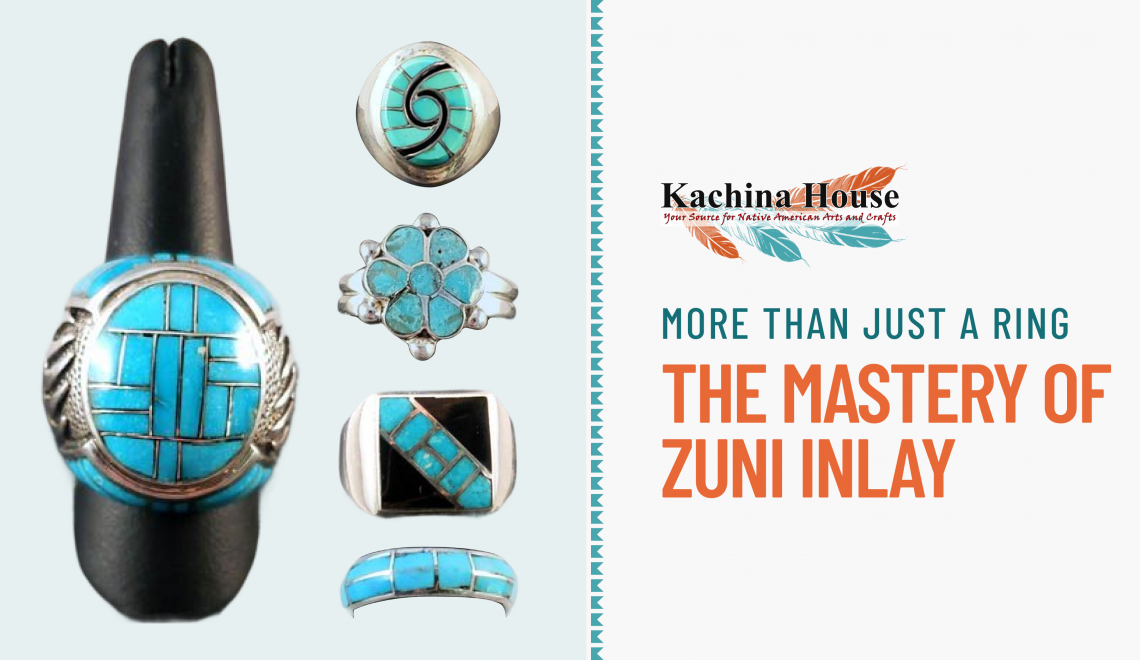
Some jewelry you wear. Some jewelry you study.
A Zuni inlay ring belongs to the second category. The closer you look, the more you see. Tiny pieces of turquoise, jet, coral and shell, each one cut by hand, each fitted like a puzzle piece into silver. No gaps. No overlap. Just a surface so flat and flush it almost doesn’t look real.
This is what Zuni lapidary work has always been about. Precision that borders on obsession.
Where This Art Comes From
The Zuni people, based in a community about 34 miles south of Gallup, New Mexico, have been working stone since prehistoric times. Zuni inlay as we know it today has a more specific origin point.
In 1932, a Zuni gem cutter named Teddy Weahkee made his first inlay piece: a knife wing bird mounted on a bow guard for ceremonial use. He had quietly figured out how to make fitted stones and shells stay permanently on a silver backing. He kept that secret to himself for years. Other gem cutters tried to copy his work. None could.
By 1934, he debuted his collection at the Inter-Tribal Indian Ceremonial. It swept every prize in its category. The art form was born.
From there, Zuni inlay took on a life of its own. Rings, bracelets, pins, earrings. Designs pulled from sacred imagery: dragonflies, rainbow gods, knife wing figures. The Zuni people brought something new into the world, and collectors noticed immediately.
How a Zuni Inlay Ring Is Actually Made
The process is slower than you’d expect, even knowing how it looks.
The artist begins by cutting individual stones to size. Each piece is shaped, ground, and polished by hand. Then it’s fitted into a silver framework called channel work, where compartments of silver separate and hold each stone. In mosaic-style inlay, there’s no silver separating the stones at all. They sit edge-to-edge with nothing between them.
Once every piece is placed, the surface is sanded flush. When it’s done right, you can run your finger across the ring and feel almost nothing. That smoothness is the goal. It’s also what takes the most time.
Turquoise is the most common stone, but jet, coral, shell, and mother-of-pearl all appear regularly in Zuni inlay rings. Some pieces include Sleeping Beauty turquoise, known for its clean sky blue with almost no matrix. Like this 1970s Zuni inlay ring with Sleeping Beauty turquoise, a vintage piece with the quiet confidence that only older work tends to carry.
How Can You Tell if a Zuni Inlay Ring Is Authentic?
This is worth knowing before you buy.
Authentic Zuni inlay has a few reliable markers. First, the surface. Real inlay sits flush. If stones feel raised or uneven, that’s a sign of lesser quality or imitation work. Second, the fit. There should be no visible gaps between stones. Zuni lapidary work is defined by precision.
Third, look for a hallmark. Signed Native American jewelry became more common in the mid-twentieth century, but many older pieces remain unsigned. When a ring is signed, it connects you directly to the artist. The 1970s Zuni inlay ring by Dickie Quandelacy is exactly that kind of piece. A name you can trace, a lineage you can learn about.
Finally, buy from a trusted source that knows its inventory. Provenance matters.
Are Zuni Inlay Rings Fragile?
They’re more durable than they look; they do need care.
The main vulnerability is moisture. Getting an inlay ring wet repeatedly can soften the adhesive beneath the stones. One jewelry collector told the story of watching her turquoise inlay slide down a rest stop drain after washing her hands. It happens. Take your ring off before washing, swimming, or cleaning.
Avoid dropping inlay rings on hard surfaces. The stones themselves won’t likely shatter, but corner impacts can chip or dislodge a piece. Store them separately from other jewelry that could scratch the surface.
Beyond that, Zuni inlay rings hold up well to daily wear. They’re meant to be worn, not locked away. The Zuni turquoise ring by Benina Kallestewa is a good example of the kind of piece that becomes a daily companion over the years.
The Range of What’s Possible
Part of what makes Zuni inlay rings so collectible is the variety. No two designs are exactly alike.
Some rings are classic and restrained, like this Zuni turquoise ring with its clean lines and confident stone placement. Others go further, combining multiple stones in geometric patterns that reward close attention. And some, like this finely detailed Zuni turquoise ring, show just how far a skilled lapidary can push the form.
One historian compared Zuni jewelry-making to Mozart. The Navajo style, they said, was Beethoven. Both are masters. But the Zuni approach is about refinement, about doing more with less space, about fitting something enormous into something small.
That description still holds.
A Living Tradition
The Zuni have been refining this art for generations. What Teddy Weahkee introduced at a 1934 ceremonial has grown into one of the most recognized styles in Native American jewelry. Every artist working in inlay today is part of that lineage.
When you wear a Zuni inlay ring, you’re wearing that history on your hand.
Browse our full collection of Zuni inlay rings at Kachina House. Each piece has been chosen with care, and every purchase goes directly toward supporting the artists who keep this tradition alive. Take your time looking. The right ring will find you.